
Why (and how!) OTs work on handwriting without worksheets
Maybe it's a handwriting sample you can barely read.
Maybe it's the way your kid grips the pencil, white-knuckled, like the pencil is the enemy.
Maybe it's cursive. Nobody seems to agree anymore on when it's taught, or why, or if it still matters.
Or maybe it's simpler than any of that. You just want to know what to actually do at home, tonight, that helps.
Handwriting is the most common reason kids get referred to occupational therapy in schools. That tracks. It's the thing everyone can see. A teacher notices it, a parent notices it, and everyone assumes the fix lives in the hand.
It usually doesn't.
What else contributes to handwriting?
Hold onto your hats because the non-exhaustive list includes:
Hand dominance
Grasping skills
Core strength
Hand strength and skills
Visual perception
Crossing midline
Hand-eye coordination
Shoulder stability
Arm and hand control
Thumb opposition and webspace
Finger isolation
Functional separation of the two sides of the hand
Before your kid can improve their handwriting, we need to know what’s causing the breakdown. And, like we just talked about, it could be coming from a bunch of different places.
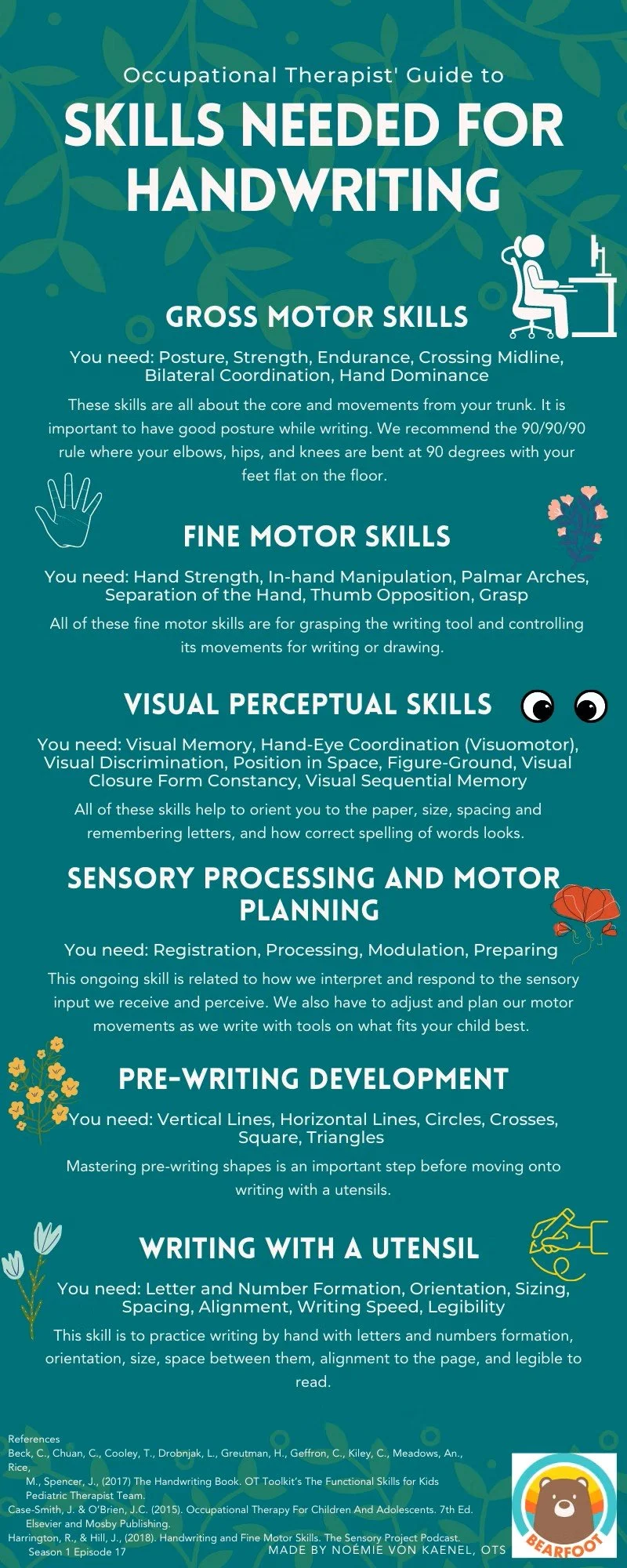
By the time a child is expected to write their name in kindergarten, plus uppercase and lowercase letters, they're actually still developmentally wired to be drawing shapes. That gap between what's asked and what's ready is bigger than most parents realize. And underneath "bad handwriting" is usually a stack of skills that have nothing to do with a pencil at all: core strength, shoulder stability, crossing midline, hand-eye coordination, thumb opposition, the ability to separate the two sides of one hand so the fingers can move independently from the wrist.
If any one of those is underdeveloped, the hand compensates. A compensating hand looks like messy letters, or a death grip on the pencil, or a kid who's wiped out after four sentences and doesn't know why.
So when a parent tells me their kid has bad handwriting, I don't reach for a worksheet. I want to know how their kid climbs. How they catch a ball. Whether they can hang from something with both arms for more than a few seconds. Whether they can crawl through a tunnel without their limbs tangling on the way through. Those tell me more than a handwriting sample ever will.
This is the whole reason we don't do fine motor worksheets at Outdoor Kids OT. A worksheet can drill a letter shape. It can't build a shoulder.
Nature does that work without ever announcing it's happening. In the East Bay, a kid climbing over a fallen log at Tilden is loading their core and stabilizing their shoulders. A kid crossing the creek at Joaquin Miller on uneven rocks is crossing midline with every step, reaching an arm across the body just to stay upright. In Madison, a kid tying off a swing rope at Token Creek Park is working thumb opposition and grip strength before they've touched a pencil all day, and a kid stringing a nature bracelet or hauling mud at Glen Canyon Park in San Francisco is doing the same fine motor work a worksheet chases, except their hands actually want to be there.
None of it looks like therapy. All of it is.
This is Novelty, one of the five principles inside our ConTiGO Approach. Kids don't get many chances anymore to climb something unpredictable, or carry something heavy over uneven ground, or use their whole body just to get from one place to another. That kind of novelty wakes a nervous system up in a way a laminated worksheet never will, and it's why every OKOT session, for kids ages 3 to 12, happens outside instead of at a table.
Handwriting isn't a hand problem you fix by writing more. It's a body problem you fix by moving more, and moving differently. The pencil is the last ten percent. The other ninety percent happened years earlier, out on a playground or a trail or in a backyard, building the strength and coordination a hand needs before it's ever asked to do something as demanding as forming letters on a line.
If handwriting is a daily fight in your house, before you buy another workbook, look at how your kid moves everywhere else. How's their core when they're standing at the sink brushing their teeth? Can they hang from monkey bars longer than thirty seconds? Do they trip over their own feet more than their friends do?
Those answers usually tell you more than the handwriting does.
If you want a second set of eyes on what you're seeing, just reply to this and tell us. We'll take it from there.
Beck, C., Chuan, C., Cooley, T., Drobnjak, L., Greutman, H., Geffron, C., Kiley, C., Meadows, An., Rice, M., Spencer, J., (2017) The Handwriting Book. OT Toolkit’s The Functional Skills for Kids Pediatric Therapist Team.
Case-Smith, J. & O’Brien, J.C. (2015). Occupational Therapy For Children And Adolescents. 7th Ed. Elsevier and Mosby Publishing.
Collette, D., Anson, K., Halabi, N., Schlierman, A., & Suriner, A. (2017). Handwriting and common core state standards: Teacher, occupational therapist, and administrator perceptions from new york state public schools. The American Journal of Occupational Therapy, 71(6), 1-9. doi:http://dx.doi.org.dominican.idm.oclc.org/10.5014/ajot.2017.021808
Feder, K., Majnemer, A., & Synnes, A., (2000). Handwriting: Current trends in occupational therapy practice. The Canadian Journal of Occupational Therapy, 67(3), 197-204. doi:http://dx.doi.org.dominican.idm.oclc.org/10.1177/000841740006700313
DOI:10.1177/000841740006700313
Grace, N., Enticott, P. G., Johnson, B. P., & Rinehart, N. J. (2017). Do handwriting difficulties correlate with core symptomology, motor proficiency and attentional behaviours? Journal of Autism and Developmental Disorders, 47(4), 1006-1017. doi:http://dx.doi.org.dominican.idm.oclc.org/10.1007/s10803-016-3019-7
Harrington, R., & Hill, J., (2018). Handwriting and Fine Motor Skills. The Sensory Project Podcast. Season 1, Episode 17
Zwicker, J. G. (2006). Effectiveness of occupational therapy in remediating handwriting difficulties in primary students: Cognitive versus multisensory interventions (Order No. MR14673). Available from Nursing & Allied Health Database. (304984389). Retrieved from https://dominican.idm.oclc.org/login?url=https://www-proquest-com.dominican.idm.oclc.org/dissertations-theses/effectiveness-occupational-therapy-remediating/docview/304984389/se-2?accountid=25281
Handwriting without Tears Website and free resources, Retrieved from<https://www.lwtears.com/programs/distance-learning/families/packets>
American Occupational Therapy Association (AOTA) (n.d.) Handwriting. Retrieved from <https://www.aota.org/About-Occupational-Therapy/Patients-Clients/ChildrenAndYouth/Schools/Handwriting.aspx>