
Why sticks, rocks, and mud beat a room full of toys
Walk into a playroom full of bright toys and it's easy to picture your child busy for hours.
The same goes for a traditional OT sensory gym. The swings, crash mats, trampolines, bins of therapy balls... you can picture your kid having a blast in there without even trying.
Then you look at what we do at Outdoor Kids OT. A small group of kids, a licensed OT, and a trail in your local park. No sensory gym. No toy shelf.
… And a very fair worry pops up. Ninety minutes in the woods with nothing to play with sounds like a LONG time, and you might wonder if your child needs all that gym equipment to make progress.
I get it. (I spent 15 years working in schools and clinics before I took my practice outdoors in 2015, so I know exactly what that equipment looks like!)
Most of us grown-ups have lost a little of our imagination. We see a stick and think... stick.
Kids see something completely different.
Raise your hand if:
→ You have a pile of rocks rolling around your car, courtesy of your kiddo
→ Your child once fell head over heels for a piece of literal junk
→ Your kiddo ignored the fancy new toy and played with the BOX it came in for a week
Those random treasures have an official name. They're called loose parts¹, and we see kids play better with them than with almost any toy you can buy.
Nature is FULL of them!
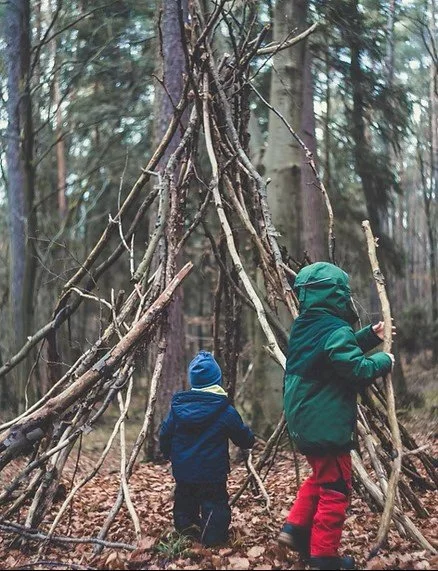
What are loose parts?
Loose parts are natural and everyday objects that kids can move, combine, take apart, and explore however they want.¹ There are no instructions and no "right" way to use them, and that's exactly what makes them so good.
A stick becomes a shovel. Then a magic wand. Then a fishing pole.
A cardboard box becomes a house, or a crash-landing zone. A pile of rocks gets sorted, stacked, and served up as pretend soup.
Kids are drawn to this kind of play because it feeds their curiosity, their drive to explore, and their need to express themselves.² Compare that to the surprise-unboxing toys... the fun lasts about as long as the unboxing. (Hello, overflowing toy bin.)
When loose parts get added to school playgrounds, kids move more and play more creatively.³
Some Examples of Loose Part Play Materials
Loose parts can come from your house or straight from the ground outside. A quick list to get you started:
Stuff from your house, yard, or recycling bin
Pots & Pans
Baskets
Chalk
Ribbons
Rope
Cardboard
Tires
Bottles
Treasures you find outside
Leaves
Rocks
Sticks
Small logs
Shells
Pods & acorns
Dirt
Feathers
Pine cones
Why open-ended play is so good for kids
Beyond being fun, loose parts give kids three big things:
Flexibility. There's no wrong answer. The same rock can be a building block for one child and a counting game for another, so kids at different skill levels can play and learn side by side.¹
Imagination. With no single job to do, loose parts invite kids to make something up.³ Rope, sticks, and leaves turn into a fairy house. Dirt and water turn into a mud pie that someone will insist you pretend to eat.
A bridge to skill building. Play is how kids practice the skills they need for life, and loose parts make that practice motivating. Kids build strength, coordination, and self-regulation without anyone calling it "work."² (This is where the OT comes in. More on that below.)
The good news for parents is that setting this up is simple (thank goodness!). Give kids safe access to loose parts, follow their lead, and watch what they come up with.
You'll be amazed how deep into it they get.
How loose parts help kids reach their OT goals
We don't need a sensory gym full of equipment, because the best play materials are already waiting on the trail.
Our therapists don't show up empty-handed, though. We carry in a few things on purpose to round out a session... a swing, scissors, a REAL hammer, chalk, some paper.
One OKOT parent told us her child's group spent sessions making nature bracelets, setting up swings, throwing birthday parties for birds (!!), and making real mud pies. Every one of those activities was working on something.
A few of the ways loose parts play supports OT goals:
Sensory
Almost every loose part has a sensory side, especially the ones from nature. Banging rocks together, building a stick fort (and knocking it down), crunching through a pile of leaves... it all wakes up the senses.
For a sensory seeker, that's a full-body yes. For a sensory avoider, a little mud on the hands can be the just-right challenge.
Self-regulation
Loose parts play is unscripted. The tower falls. The stick snaps. Someone else wants the same log.
Every one of those moments is a chance to practice handling frustration, adjusting the plan, and keeping control of your body.² Our therapists are right there to co-regulate, meaning they stay calm so your child can borrow that calm.
Social Skills
Loose parts invite shared missions. Building a fort with three friends means negotiating, sharing ideas, and taking turns.²˒⁴
In our small groups, those little conflicts over who gets the big stick ARE the therapy.
Strength
Rocks and branches are heavy! Hauling them around is a workout kids don't even notice.³
Coordination
Stacking, carrying, and building all take coordination. And because kids WANT to finish that fairy house, they're less likely to give up when it topples the first time.⁵
That repetition is where coordination grows.
Attention & Problem Solving
Hand a child a pile of loose parts and they have to figure out what to do with it. Whether they build something new or sort everything by size, they're working on attention, organization, and making a plan.
Loose parts play has been shown to boost engagement, attention, and problem-solving.⁴
Play materials + expertise
Loose parts are everywhere, and most of them are free. There's nothing stopping you from getting these benefits at home with your own kid.
(Please DO let them raid the recycling bin or the rock pile.)
What makes an OKOT session different is everything we build around the play.
We pick wild, "away" spots in parks like Tilden and Joaquin Miller in the East Bay, Glen Canyon and the Presidio in San Francisco, and Token Creek and Glen Oak Hills in Madison, far from buildings and cars, so kids' nervous systems can settle and their attention can recover.
Every session follows our ConTiGO Approach, and novelty (old-fashioned games, outdoor skills, natural materials, and yes, loose parts) is one of its five core principles.
And our therapists know how to adjust in the moment when a child's body or big feelings need something different.
Your kid gets to have an amazing time, be fully themselves, and work toward their goals... all in the same afternoon.
If your child has sensory, motor, or social-emotional challenges and you live in the Bay Area or Madison, take a look at our Group OT, Individual OT, and Summer Camp programs.
References
Daily, L. & Beloglovsky, M. Loose Parts: Inspiring Play in Young Children.
Daly, L. and Beloglovsky, M. (2015) Loose Parts: Inspiring Play in Young Children. Redleaf Press: St Paul p.x.
Maxwell, L. E., M. R. Mitchell, and G. W. Evans. 2008. Effects of play equipment and loose parts on preschool children’s outdoor play behavior: An observational study and design intervention. Children, Youth and Environments, 18 (2), 36-63.
Science Daily (2014) Health benefits from free play confirmed by research. https://www.sciencedaily.com/releases/2014/03/140303083547.htm
Cogorno Maldonado, Rossana. (2021). The Impact of Extended Recess with Loose Parts Play on Montessori Primary Student Self-Regulation and On-Task Behaviour. Retrieved from Sophia, the St. Catherine University repository website: https://sophia.stkate.edu/maed/401
Kuo, M., Barnes, M., & Jordan, C. (2018). Do Experiences With Nature Promote Learning? Converging Evidence of a Cause-and-Effect Relationship. Frontiers in Psychology. https://doi.org/10.3389/fpsyg.2019.00305