
Playing Hard is Working Hard: Learning Through Play
People ask us all the time: "So... do you just play with kids all day?"
Yep. And we love every single minute of it!
But here's what that question gets wrong. Play isn't what children do instead of learning. It is how they learn. In occupational therapy, play is considered a child's primary occupation — the meaningful, purposeful activity through which children build every skill they will need for the rest of their lives.
What looks like "just playing" is doing a LOT of complex developmental work.
I've been an OT for over 20 years, and I still get a little nerdy-excited every time I watch kids play. Because once you understand what's happening underneath all that running and arguing and hiding and laughing, you can't unsee it.
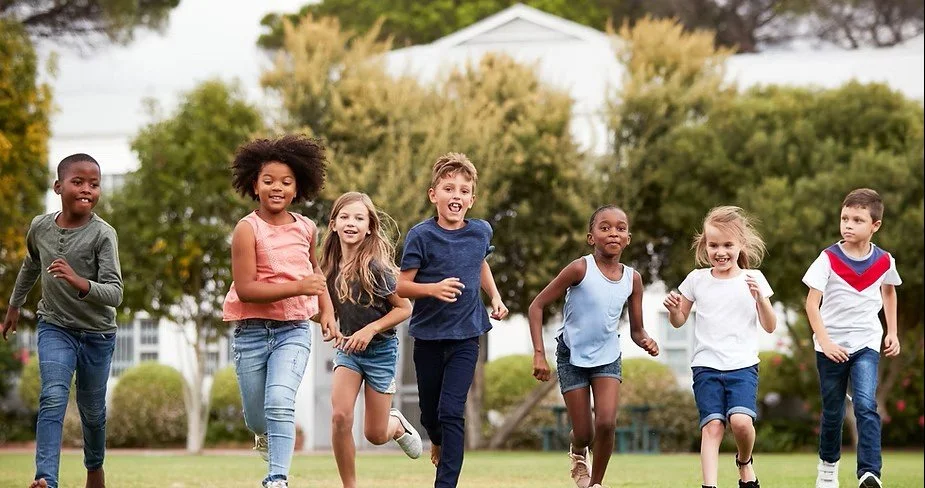
What's Actually Happening When Kids Play
Let me paint you a picture.
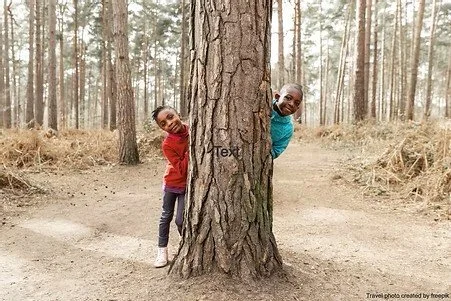
Two kids decide to play hide-and-seek on the playground. Simple enough, right?
One of them wants to be the seeker first. The other one doesn't agree. Negotiations ensue. Rules get established. Someone has to be flexible. Someone has to advocate for themselves. Someone counts out loud to twenty with their eyes closed while fighting every instinct to peek. Someone else scans the entire playground in about three seconds and makes a split-second decision about where to hide.
Jill finds Jack. Jack is NOT happy about it.
And then... Jack regulates, takes his turn, and they keep going.
In that one five-minute game of hide-and-seek, these two kids practiced negotiation, communication, cooperation, advocacy, cognitive flexibility, impulse control, numerosity, problem-solving, spatial reasoning, gross motor coordination, emotional regulation, and turn-taking — all while simultaneously processing the sound of other kids screaming, the feel of mulch under their feet, and the sensory experience of running in the sun.
That is not "just playing." That is some of the hardest developmental work a child does all day.
And it's why, when play doesn't go smoothly, when a child can't tolerate losing, can't read the social cues to join a game, can't regulate well enough to stay in their body when something goes sideways — it matters. A lot. That's not a quirk to wait out. Those are skills that can be learned, practiced, and built, and that's exactly what we do at Outdoor Kids OT.
Why We Take Every Single Session Outside
We run our groups and individual sessions outside in local parks. Every week, outdoors, in all weather. And families sometimes ask us: why does it have to be outside?
Because the research on what outdoor play does to children's bodies and brains is genuinely hard to ignore.
When children play in unstructured natural settings, studies show:
Academic attention and performance improve
Balance, coordination, and motor fitness increase, more than on traditional playgrounds
Serotonin production is supported, which shapes calmness, attention, memory, and feelings of wellbeing
Sleep quality improves through natural light and physical exertion
And for our kids especially: social connection deepens, because nature invites exploration and curious peers naturally follow
But beyond the research, here's what I've seen after 11 years of running sessions at OKOT: nature makes children available in a way that a clinic room, a gym, or a manicured park simply doesn't.
When a child walks into a sensory gym, they're already working hard just to cope with the fluorescent lights, the smell, and the strange equipment. By the time therapy "starts," they're already dysregulated. Outside, in a forest, something different happens. Nervous systems settle. Children breathe differently. The just-right challenge of an uneven trail or a muddy creek bank calls to something in them that a swing set just can't reach.
That's not incidental. It's the whole point. Nature isn't the backdrop for our therapy. It's the therapeutic medium itself, which is why we've built the ConTiGO Approach around it.
"But It's Dangerous Out There!"
I hear this one from parents, and I get it. We're wired to protect our kids, and somewhere along the way, our culture decided that protection meant removing every possible risk from their path.
I want to gently push back on that.
There's a really important distinction between risk and danger, and most of us have been taught to treat them as the same thing. They're not.
Danger is what we work to avoid: genuine threats to physical safety, situations where a child could be seriously hurt.
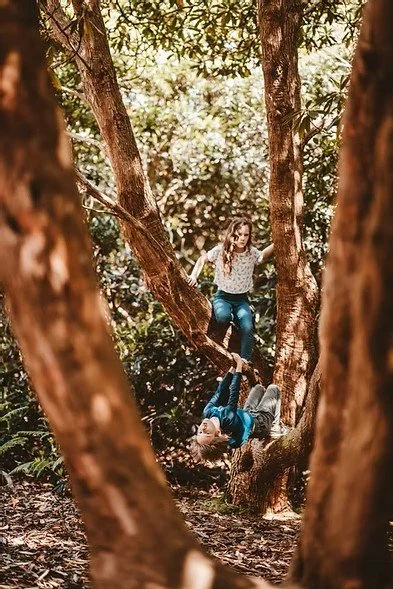
Risk is something else entirely. Risk is a child standing at the edge of a big rock, deciding whether to jump. Risk is a wobbly log bridge over a shallow creek. Risk is climbing higher than feels comfortable and figuring out how to come back down on their own.
That kind of risky play is where children learn to tolerate nervousness and move through it anyway, to assess their own physical capabilities honestly, and to experience genuine pride — the kind that can't be manufactured on a sensory swing in a padded room. It has to be earned.
Researchers Brussoni and colleagues put it beautifully: the goal for children's play shouldn't be "as safe as possible," but "as safe as necessary." We've written more about this on the blog — this post on Letting Kids Do Dangerous Things goes deeper if you want to read more.
Getting Your Kids Outside More
You don't need to overhaul your family's whole routine to shift this pattern. Small, consistent steps matter more than grand plans.
Go outside with them. Kids learn by watching, and most want to be wherever you are. Ten minutes in the backyard after dinner counts.
Follow their interests outdoors. Does your kid love superheroes? Bring that outside. Is she obsessed with drawing? Take the sketchbook to the park. Nature doesn't have to compete with what they love — it can host it.
Make outdoor time a transition, not an event. Stopping at a park on the way home from school three days a week is more sustainable than a two-hour Saturday expedition that has to be planned around naps and snacks and moods.
Build an adventure jar. Fill it with slips of paper: blow bubbles, water the tomatoes, go on a bug hunt, find something soft and something rough and something sharp. When kids choose from the jar, it becomes fun instead of a battle of wills.
When Play Doesn't Go Smoothly
Play doesn't always look like two kids running happily through the woods together. Sometimes it looks like a meltdown over the rules of a game. Sometimes a child stands at the edge of a group of kids for twenty minutes and can't figure out how to get in. Sometimes the sensory demands of being outside (the noise, the mud, the unpredictability) are genuinely too much.
That's not a sign something is wrong. That's a signal that there's growing to do.
Every fail-learn on the playground is data. It tells us exactly where a child's nervous system needs support, where their social skills have a gap, where their sensory processing is getting in the way of the life they want to be living.
And that's precisely the work we do. At OKOT, sessions happen in the great outdoors — not despite the mud and the unpredictability, but because of it. Real growth happens in real contexts, not on a laminated checklist of home exercises.
If your child is heading into the new school year and you're wondering whether they need more support than the playground is giving them, we'd love to learn more about them.
References:
Alexander, S. A., Frohlich, K. L., & Fusco, C. (2014). Playing for health? Revisiting health promotion to examine the emerging public health position on children's play. Health promotion international, 29(1), 155–164. https://doi.org/10.1093/heapro/das042
Bento, G., & Dias, G. (2017). The importance of outdoor play for young children's healthy development. Porto Biomedical Journal, 2(5), 157-160. https://doi.org/10.1016/j.pbj.2017.03.003
Brussoni, M., Olsen, L. L., Pike, I., & Sleet, D. A. (2012). Risky play and children's safety: balancing priorities for optimal child development. International journal of environmental research and public health, 9(9), 3134–3148. https://doi.org/10.3390/ijerph9093134
Coyle, K. J. Green Time for Sleep Time Three Ways Nature and Outdoor Time Improve Your Child’s Sleep A Guide for Parents and Caregivers. Retrieved fromhttps://www.nwf.org/~/media/PDFs/Be%20Out%20There/BeOutThere_GreenTimeforSleepTimeReport_September2011.ashx#:~:text=The%20main%20idea%20is%20to,nature%2C%20natural%20light%20and%20activity.&text=A%20little%20time%20outdoors%20in,a%20significant%20sleep%20quality%20difference.
Dowdell, K., Gray, T.L., & Malone, K.A. (2011). Nature and its Influence on Children’s Outdoor Play. Australian Journal of Outdoor and Environmental Education, 15, 24-35.
Park, M., & Riley, J. Play in natural outdoor environments: a healthy choice. Dimensions of Early Childhood, 43(2), 22-28.
Yogman M, Garner A, Hutchinson J, et al; AAP COMMITTEE ON PSYCHOSOCIAL ASPECTS OF CHILD AND FAMILY HEALTH, AAP COUNCIL ON COMMUNICATIONS AND MEDIA. (2018) The Power of Play: A Pediatric Role in Enhancing Development in Young Children. Pediatrics.142(3):e20182058